
Precision Core Load and Force Sensors for Industrial Accuracy
Engineered for durability and precision across tension, compression, and multi-axis force measurement applications.
Core load and force sensors provide accurate measurement of weight, tension, compression, torque, and applied force across industrial, commercial, and engineering applications
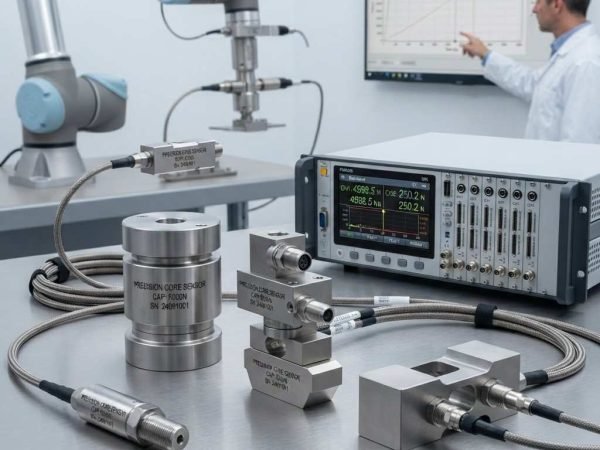
Core load and force sensors are integral to precision measurement in industrial, structural, and engineering applications. These sensors convert mechanical force into measurable electrical signals, allowing for real-time monitoring, diagnostics, and control. This content highlights a full range of sensor technologies, including tension, compression, and multi-axis configurations, all designed to deliver dependable performance under demanding conditions. From automation systems to structural testing and material analysis, these sensor solutions play a vital role in maintaining safety, improving efficiency, and supporting engineering accuracy. Explore our range of compression load cells and multi-axis load cells to find measurement solutions for different industrial requirements. Load Force Measurement, a North America-based B2B company, brings proven expertise in delivering dependable sensor systems. Our portfolio includes high-performance load cells backed by innovative design, expert support, and rigorous quality control. We help clients meet complex measurement needs with scalable, future-ready technology that supports mission-critical performance.
Overview of Core Load and Force Sensors
Case Study 1: U.S. Wind Turbine Structural Testing (Colorado)
A wind energy firm used Load Force Measurement’s compression load cells to monitor axial loads on turbine foundations. The sensors delivered continuous load tracking during field testing, helping engineers validate structural design performance and fatigue resistance.
Case Studies
Core Load and Force Sensors
Load Force Measurement offers an extensive selection of core load and force sensors, engineered to deliver accurate and reliable performance across diverse measurement environments. From ultra-compact designs to robust, high-capacity sensors, our solutions are tailored for industrial, research, and commercial use
Tension Load Cells
Our tension load cells are purpose-built to measure pulling forces with exceptional accuracy. Ideal for crane operations, cable tensioning, and mechanical lifting systems, these sensors are constructed with durable materials and high-sensitivity components to ensure consistent performance. Load Force Measurement's tension load cells offer excellent signal stability, low deflection, and resistance to environmental fluctuations, making them suitable for both static and dynamic applications
Compression Load Cells
Compression load cells from Load Force Measurement are designed to withstand high vertical loads in testing and operational scenarios. These sensors are commonly deployed in structural validation, industrial weighing platforms, and load-bearing assessments. With robust mechanical designs and sealed housings, our compression sensors ensure long-term stability and precise force measurement—even under extreme compression forces
S-Type Load Cells
S-Type load cells offer a versatile solution for both tension and compression measurements. Their compact “S” shaped form factor allows easy integration into machinery and test setups. Suitable for hopper scales, press applications, and force verification setups, these sensors are available in a wide range of capacities. Our S-Type models feature high linearity, overload protection, and compatibility with digital and analog systems
Pancake (Universal) Load Cells
Also known as universal load cells, pancake load cells are designed for high-capacity force measurements in both directions. These sensors provide consistent performance under axial load applications and are often used in materials testing machines, aerospace load frames, and automotive component testing. Load Force Measurement’s pancake cells feature low-profile construction, high stiffness, and minimal off-axis sensitivity for optimal accuracy
Miniature Load Cells
Miniature load cells deliver precise measurement in space-constrained environments. Perfect for medical devices, robotics, and compact industrial assemblies, these sensors offer full-scale accuracy in a small footprint. We offer multiple shapes and configurations, including button-style and inline versions, with options for sub miniature wiring and environmental sealing for harsh environments
Multi-Axis Load Cells
Our multi-axis load cells are engineered to measure forces and moments along multiple axes simultaneously—ideal for advanced research, robotic control, and motion simulation platforms. Load Force Measurement provides multi-axis sensors that deliver real-time vectorized data with high resolution and minimal cross-talk between channels. These systems enable comprehensive force analysis in complex, multi-dimensional applications
Industrial measurement applications often need more than a sensor alone. Compatible signal processing equipment prepares outputs for monitoring and control systems. Use load cell interface cables and junction boxes for connections, and consider wireless load cell modules where cabling is impractical. For broader industrial connectivity and sensor network applications, explore industrial IoT technologies from ElectronIQ AI. Compatibility depends on sensor output, excitation requirements, channel capacity, and the DAQ system’s supported inputs.
Sensor Integration and Data Acquisition
Ready to elevate your force measurement capabilities?
Looking for precision load and force sensing solutions? Contact Us today to learn how Load Force Measurement can support your projects. Whether you need custom sensor designs, integration support, or expert consultation, our team is ready to assist. Get in touch for quotes, product details, or engineering guidance—we’re here to help you measure with confidence
Frequently Asked Questions About Core Load and Force Sensors
Find answers to common questions about industrial load cells, force sensors, torque transducers, applications, and measurement system compatibility.
What are core load and force sensors?
Core load and force sensors are measurement devices used to detect weight, tension, compression, torque, and other applied forces. Common types include load cells, force transducers, torque sensors, and force gauges. They convert mechanical input into measurable signals for industrial monitoring, testing, and engineering applications.
What is the difference between a load cell and a force sensor?
A load cell is a type of force sensor commonly used to measure weight or applied force. The term force sensor is broader and includes devices for tension, compression, torque, and multi-axis measurement. The best choice depends on the measurement direction and application.
What types of load cells are used in industrial applications?
Industrial applications use compression, tension, S-type, single-point, shear beam, miniature, and pancake load cells. Each suits different mounting arrangements, capacities, and conditions. Selection should consider the required force range and operating environment.
What is a tension and compression sensor?
A tension and compression sensor measures both pulling and pushing forces. It is commonly used in material testing, mechanical testing, structural monitoring, and equipment verification. S-type load cells are one example that can support both directions when properly installed.
What is a torque transducer used for?
A torque transducer measures rotational force on a shaft or mechanical component. It is used in motor testing, drivetrain analysis, rotating machinery evaluation, and product development. Depending on design, it can support static or dynamic measurement.
How do you choose the right load cell?
Choose based on capacity, accuracy, sensitivity, loading direction, mounting requirements, environmental conditions, and electrical output. Also consider compatibility with the signal conditioner, indicator, PLC, or data acquisition system that processes the measurements.
Where are industrial force sensors used?
They are used in manufacturing, material testing, aerospace, automotive engineering, structural monitoring, robotics, and research laboratories. They measure applied forces, validate mechanical performance, monitor equipment, and support quality control.
Can load and force sensors connect to data acquisition systems?
Yes, compatible sensors can connect to data acquisition systems through suitable signal conditioning and interface equipment. The required configuration depends on sensor output, excitation requirements, channel capacity, and the DAQ system's supported inputs.