
Load Cell Signal Conditioners and Amplifiers
Engineered signal conditioners and amplifiers built for load cell accuracy, integration, and industrial reliability.
Signal conditioners and amplifiers engineered for load cell accuracy, integration, and industrial reliability.
Overview
Tension Load Cells
What Are Load Cell Signal Conditioners and Amplifiers?
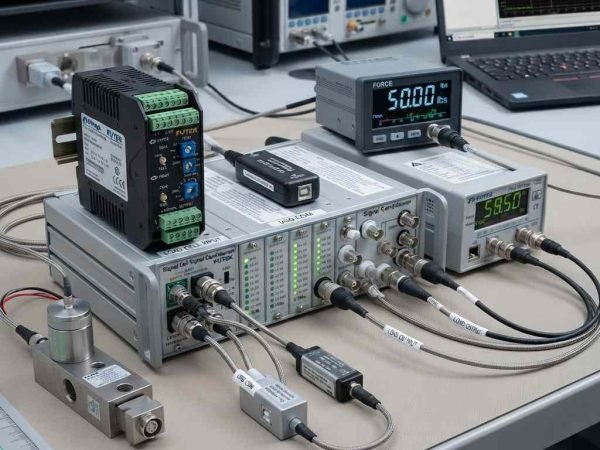
Load cell signal conditioners and amplifiers are electronic devices that process the low-level electrical signals generated by strain gauge load cells and other force sensors. They provide amplification, filtering, and conditioning to prepare sensor outputs for measurement and control equipment. Depending on the model, they convert millivolt-level signals into standard analog outputs such as 0–10 V, ±10 V, and 4–20 mA, or into digital formats such as RS485 and Modbus. They help connect load cells with PLCs, data acquisition systems, industrial controllers, and monitoring platforms.
Load Force Measurement, a B2B company based in San Bernardino, CA, provides signal conditioning products and integrations for industrial weighing, force measurement, structural monitoring, and automation across North America. This page explains how signal conditioners work, the types available, and how to choose one. Related pages: data acquisition systems, digital load cell indicators, and interface cables and junction boxes.
GAO Tek High-Precision Strain Gauge Signal Conditioner
- Converts microvolt-level strain signals to ±10V/4–20mA
- Low-noise output, wide input voltage range
- Suited for bench testing and industrial integration
GAO Tek RS485 Load Cell Signal Amplifier
- Modbus-compatible output for direct PLC integration
- Compact DIN rail housing, adjustable gain, and filter options
- Ensures long-distance signal integrity
GAO RFID Wireless Signal Transmitter Module
- Amplifies and sends sensor signals wirelessly
- Excellent for rotating, moving, or remote sensor points
- Battery-operated with long-range transmission
Software and Systems
GAO Tek Signal Conditioner Configurator Software
- Provides real-time gain, offset, and filter tuning
- Visual monitoring of signal health and diagnostics
- Easy calibration via PC interface
GAO RFID Load Cloud Dashboard
- Central platform for wireless signal monitoring
- Includes real-time analytics, custom alerts, and reports
- Multi-device access with secure cloud login
GAO Tek Data Acquisition Suite for RS485 Systems
- Logs, visualizes, and exports signal data in real time
- Connects directly with RS485 output amplifiers
- Ideal for SCADA, lab, and quality control use cases
Core Components
Hardware Products (from GAO Tek & GAO RFID)
Partnerships
Comprehensive Solutions with Trusted Technology Partners
In addition to offering products and systems developed by our team and trusted partners for Signal Conditioners and Amplifiers, we are proud to carry top-tier technologies from Global Advanced Operations Tek Inc. (GAO Tek Inc.) and Global Advanced Operations RFID Inc. (GAO RFID Inc.). These reliable, high-quality products and systems enhance our ability to deliver comprehensive technologies, integrations, and services you can trust. For additional electronics and industrial technology solutions, explore Electroniq AI. Where relevant, we have provided direct links to select products and systems from GAO Tek Inc. and GAO RFID Inc.
Key Features and Functionalities
High signal-to-noise ratio amplification for precise load readings
Programmable gain and filtering for field adaptability
Supports analog outputs (±10V, 4–20mA) and digital outputs (RS232, RS485)
Built-in noise filtering and zero-offset calibration
Real-time diagnostics and remote tuning on select models
Compatibility
- Interfaces with load cells, strain gauges, torque sensors, and displacement transducers
- Works with DAQ systems, PLCs, HMIs, digital indicators, and SCADA
- Compatible with USB, RS485/Modbus, wireless, and analog systems
- Integrates into existing industrial, lab, and field monitoring setups
Applications
- Structural load monitoring and bridge inspections
- Material testing machines and automation platforms
- Industrial weighing systems and batching operations
- Aerospace structural testing and validation
- Heavy machinery feedback and fault monitoring
Industries We Serve
- Construction & Structural Engineering
- Aerospace & Defense
- Automotive & Mobility
- Utilities & Energy
- Mining & Resource Extraction
- Robotics & Industrial Automation
Industries We Serve
- Construction & Structural Engineering
- Aerospace & Defense
- Automotive & Mobility
- Utilities & Energy
- Mining & Resource Extraction
- Robotics & Industrial Automation
Relevant U.S. and Canadian Industry Standards
- ASTM E74 – Calibration of Force-Measuring Instruments
- IEEE 1451 – Smart Transducer Interface for Sensors and Actuators
- ASME B106
- CSA S157
1. Industrial Automation, Michigan, USA
Industrial Automation, Michigan, USA An automation integrator implemented our signal conditioners to ensure clean analog input from load cells across robotic arms. This reduced calibration drift and increased robotic accuracy, improving production yield by 14%.
2. Aerospace Testing Facility, Texas, USA
Our programmable signal amplifiers helped a Texas aerospace firm gather reliable force data in high-frequency aircraft wing simulations. Engineers used the filtered outputs for FAA-certified structural modeling
3. Structural Monitoring Project, Alberta, Canada
A Canadian firm deployed ruggedized outdoor signal conditioners in bridge cable tension monitoring. Our weather-resistant modules maintained accurate readings through winter freeze cycles and heavy vehicle vibrations
Case Studies
Need guidance choosing the right signal conditioning solution for your application?
Contact Load Force Measurement for expert assistance, product specs, or system integration support. Our team is ready to help you succeed with high-performance solutions
Frequently Asked Questions About Signal Conditioners and Amplifiers
Find answers to common questions about load cell signal conditioners, amplifiers, signal outputs, noise reduction, and industrial integration.
What is a load cell signal conditioner?
A load cell signal conditioner is an electronic device that processes the low-level electrical signal from a load cell. It can provide signal amplification, filtering, excitation, and output conversion so the signal suits weighing indicators, PLCs, and data acquisition systems.
What is the difference between a load cell amplifier and a signal conditioner?
A load cell amplifier mainly increases the strength of the sensor's output. A signal conditioner can also provide excitation, filtering, calibration, isolation, and conversion to standard analog or digital outputs. The exact capabilities depend on the device.
Why do load cells need signal conditioners?
Load cells produce very small electrical signals that industrial controllers cannot use directly. Signal conditioners amplify and process these signals so they can be measured reliably and integrated with controllers and data acquisition systems.
What output signals do load cell signal conditioners support?
Depending on the model, outputs include analog signals such as 0–10 V, ±10 V, and 4–20 mA, and digital interfaces such as RS232, RS485, and Modbus. Confirm output compatibility against your equipment's specifications.
Can a load cell signal conditioner connect directly to a PLC?
Yes, when the PLC input matches the conditioner output. Common connections use 0–10 V, 4–20 mA, or RS485 Modbus. Check that the PLC input is configured for the signal type and range you choose.
What is a strain gauge signal amplifier?
A strain gauge signal amplifier increases the small electrical output of strain gauge sensors so that instruments, controllers, and data acquisition systems can process it more easily.
How do you reduce noise in load cell signals?
Use shielded cables, proper grounding, electrical isolation, signal filtering, correct wiring, and a suitable amplifier. Keep signal cables away from motors, drives, and other sources of electrical interference.
How do you choose a load cell signal conditioner?
Choose based on the load cell's sensitivity, excitation needs, number of cells, required output, accuracy, filtering, environment, and compatibility with your PLC, DAQ, or monitoring equipment.